
What Pressures Are Businesses Facing Thanks to UK Business Rates?

Tom Dymond Partner - Head of Property Services
The 2025 Autumn Budget announced a package of measures aimed at supporting businesses in England following rising business rates due to a combination of inflation, property revaluations and the aftermath of COVID-19. With revaluation changes and ongoing pressure on operating costs, the new measures are designed to provide stability, protect smaller businesses, and support growth across key sectors.
However, the latest research from the British Chambers of Commerce (BCC) has revealed that more than half of all firms currently plan to increase their prices due to the rising cost pressures. The BCC is therefore asking the Treasury to rethink its plans due to the anxiety of the changes reaching a record high. The hospitality, manufacturing and logistics sectors face the highest levels of concern, with BCC data from February 2024 showing that 27% of businesses have already had to scale back or cancel plans to expand due to business rates costs.
In this blog, we break down business rate changes and what they mean for UK businesses.
BUSINESS RATES RELIEFS
Transitional Relief Scheme: To support ratepayers facing sharp bill increases at the revaluation, the government is introducing a redesigned Transitional Relief Scheme worth £3.2 billion.
Supporting Small Business Scheme (SSB): For businesses losing some or all of their small business rates relief or rural rate relief. Bills will be capped at £800, or the relevant transitional relief caps from 1 April 2026. The 2026 SSB relief scheme has been expanded to ratepayers losing their Retail, Hospitality and Leisure (RHL) relief. The government has also announced a one-year extension of the 2023 Supporting Small Business scheme from 1 April 2026. You can read more about the SSB scheme here.
100% relief for Eligible Electric Vehicle Charging Points and Electric Vehicle only forecourts: This is a ten-year 100% business rates relief for EVCPs separately assessed by the VOA and Electric Vehicle only forecourts to ensure that they face no business rates liability.
Business Rates Multipliers: Qualifying Retail, Hospitality or Leisure (RHL) from 2026
From April 2026 the government will replace retail, hospitality and leisure relief with two lower business rates multipliers for properties with rateable values below £500,000.
New multipliers from April 2026:
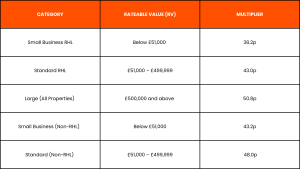
RHL: Retail, Hospitality and Leisure
Multipliers shown in pence per pound of Rateable Value (RV).
How are Small businesses in Retail, hospitality and leisure affected by the business rates?
Cafes, shops and hairdressers are just some of the small businesses that have been heavily affected by the business rates for at least three years now. The Federation of Small Businesses (FSB) revealed that they’ve received a 52% spike in bills. This is due to the removal of business rates for 230,000 small businesses across the RHL sectors.
Similar to the BCC, the FSB is urging the ministers to adjust the relief to make it available to those small RHL businesses.
FSB Policy Chair, Tina McKenzie, said:
‘Striving small businesses in retail, hospitality and leisure – from bakeries and coffee shops to garden centres, gyms and dry cleaners – are on the brink unless the Chancellor makes a decisive intervention now.
‘Combined with other cost pressures going up in April as well, the Chancellor has to be realistic that without action on business rates relief, the burden will become too much to bear for some, who will either shrink or close down altogether.’
Pubs Are Given Support After Facing Higher Business Rates
According to the BCC, 1/3 of UK firms are worried about their business rates. It’s seen to affect the hospitality sector the most, with manufacturing and logistics following close behind.
There have been reports that pubs, in particular, would face higher business rate bills as a result of the revaluation. The trade association UK Hospitality has said that “in 2027/28, an average pub’s rates will be £4,500 higher than today”.
Because of this, it was announced by the government on Tuesday, 27 January, that pubs and music venues in England will be given a 15% discount on their business rates bills from April 2026. They will also not see increases in their bills for 2 years.
How can you prepare for the new business rates?
With changes coming into force from April 2026, now is the time for businesses to prepare by reviewing their cost structures and understanding how the new measures may affect them. Identifying potential pressure points early makes it easier to put strategies in place and avoid last-minute decisions.
If you operate in retail, hospitality, leisure, logistics, or manufacturing, proactive planning will be critical to managing future costs.
Contact our specialist Property Advisory team today to see how we can support you through these changes, provide tailored advice and ensure your business is well-positioned for the year ahead.

For support with business rates
Fill out the form below for a free consultation to discuss business rates and the reliefs available to you.
*required
This site is protected by hCaptcha and its Privacy Policy and Terms of Service apply.
- Phone 0330 088 7111
- Email enquiries@tc-group.com
You might be interested in...

26 Nov 2025
Headlines from the 2025 Autumn Budget
TC Group summarises the 2025 Autumn Budget, highlighting the key tax and policy changes affecting personal finances and business planning.
Learn more
Headlines from the 2025 Autumn Budget09 Jan 2026
Income tax rate changes to dividends, savings and property income
Income Tax changes from the 2025 Autumn Budget, with new measures affecting dividends, savings and rental income from 2026 and 2027.
Learn more
Income tax rate changes to dividends, savings and property income08 Aug 2025
A boost for SMEs: The Government’s new Small Business Plan
The newly announced Small Business Plan is a strong signal that UK Government is serious about backing SMEs. Read the four key areas of the plan.
Learn more
A boost for SMEs: The Government’s new Small Business Plan
06 Oct 2026
HOW TO REDUCE YOUR INHERITANCE TAX BILL
Inheritance tax planning is about more than reducing a future tax bill. The right strategy can help protect your wealth, prevent valuable assets from being sold to meet an IHT liability and ensure your family has the funds and information they need to guarantee peace of mind.
Learn more
HOW TO REDUCE YOUR INHERITANCE TAX BILL