

M&A Trends for the Recruitment Sector

James Price Partner
What 2025 deal trends mean for recruitment exits in 2026
2025 has been a challenging year for the sector with significant headwinds affecting even the biggest beasts. As ever though those in the sector prove to be a resilient bunch and whilst economic growth forecasts aren’t exactly stellar, they do at least provide a stable backdrop for decision making which should in turn lead to improved market conditions in 2026.
Another observation is that there has been a sharp focus from management teams on right-sizing their business, looking for an increased yield from consultants as well exploring a tech stack that can perform certain business functions at a lower price point than would be the case with employing staff, and also look to tweak business models such that revenue can become more recurring and predictable.
From an M&A perspective, 2025 got off to a quiet start in the UK generally. This is widely accepted to be due to a large number of deals being accelerated into Q4 2024 in advance of the changes to capital gains tax. An uptick in Q2 has given way to another drop off in Q3 perhaps not helped by the extraordinary lead up to the Autumn Budget Speech.
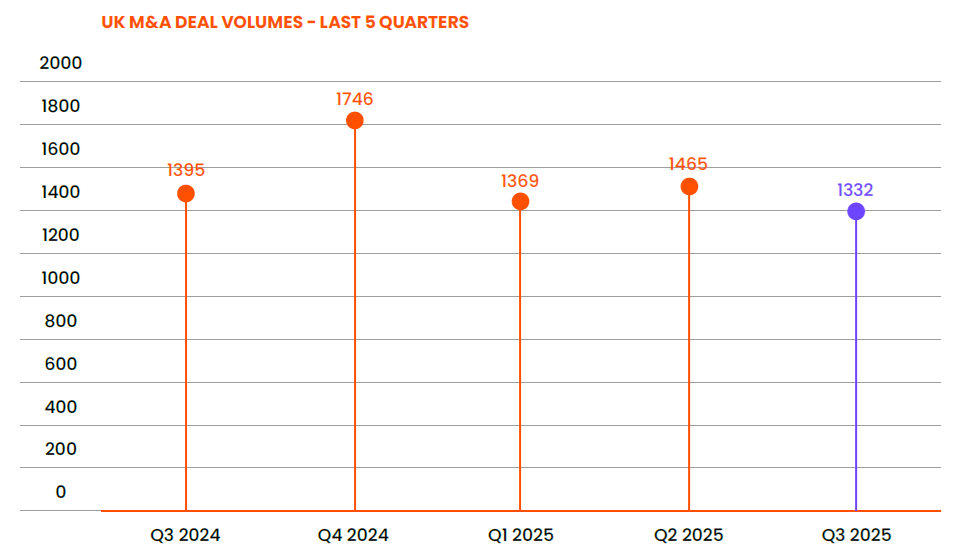
What about the recruitment sector specifically? As the graph below (Source: MarktoMarket) shows the sector is following the wider national trend quite closely in respect of deal flow and whilst empirical data is thin on the ground there’s no evidence to suggest the sector is bucking the trend on exit multiples achieved earlier, with the median EV/EBITDA1 falling from 7.3 to 6.3 (Q3 2024 vs Q3 2025).

WHAT OF THE FUTURE?
Conversations with business owners reveal a keen interest in M&A as part of wider growth plans, alongside organic initiatives, and we’d certainly expect to see trade sales remain the most frequently seen exit route through 2026, with many overseas trade buyers still attracted to the UK.
Private equity (PE) funds are still sitting on dry powder and we’d expect as ever to see platform and buy & build acquisitions a feature next year. What we would say is that PE are increasingly, across their entire portfolios, wishing to see an effective harnessing of AI by investee businesses.
High quality management teams and high-quality businesses as ever will create Management Buy Out (MBO) opportunities such as the Tatton Recruitment deal completed in August 2025.
Vertical markets we’d expect to see include STEM and professional services partly because of where PE funds are being deployed.
A relatively uncomplicated deal in the recruitment sector reported in August 2025 which provides us with some intelligence on the current state of play was the acquisition by Gattaca plc of Infosec People Ltd, a boutique recruiter specialising in cyber security and technology placements. PLCs are helpful buyers as they need to disclose information to their investors, and in this case we are told:
“….. Gattaca is also pleased to announce that it has acquired the entire issued share capital of Infosec People Limited (“Infosec”) for an aggregate cash consideration of £2.1m, consisting of an initial payment of £1.5m with deferred consideration of up to £0.6m (“Deferred Consideration”). The Deferred Consideration is payable over the next four years, subject to minimum performance criteria being achieved by Infosec within each year.
Infosec is a specialist cyber security recruitment consultancy, based in Cheltenham, UK. Founded in 2009, the business works with clients across a variety of sectors providing cyber and information security specialists.
In the year to 31 March 2025, Infosec had net fee income of £1.5m, generating an adjusted operating profit of £0.4m and had net assets of £1.0m as at 31 March 2025.”
What might this tell us about the Enterprise Value paid?
Well, if we assume a price adjustment for net free cash of £300K (an estimate based on the target’s balance sheet at 31 March 2025), then we have an initial consideration of 3 x adjusted operating profit (£1.2m), that moves to 4.5 x operating profit if we fully measure the deferred consideration (and I’m not sure I would).
Do those multiples sound a bit on the low side – we think so. What might be driving that? A few ideas as to value drivers, and value detractors would be:
✔ Niche Operator
✔ Growing Vertical Market (Tech Space)
× Sole Director (Perhaps Indicative of High Degree of Reliance)
× Scale (Below £500K of EBIT is going to mean no PE interest, and will also rule out many trade buyers)
At the severe risk of over-simplification then for owners starting to evaluate their exit options next year, here are three things you might focus on that would improve the quality of earnings in the eyes of buyers:
- Closely examine your existing vertical markets and the potential to enter new markets;
- Harness AI to increase efficiencies and free up our best people to get close to existing and new customers; and
- I f your revenue streams are lumpy and unpredictable, consider resetting your relationships with customers to reflect a partnership approach to filling roles for them.
Recruitment Sector Outlook 2026
For more guidance, insights, and articles on the recruitment, download our 2026 Recruitment Sector Outlook.
You’ll find practical guidance on international expansion, long term incentive plans, tax updates, marketing tips, operations developments and M&A insights, as well as thought leadership from networks and advisors who spend their time in and around recruitment boardrooms.
Download Recruitment Sector Outlook
The Recruitment Sector Outlook is produced by Recruitment Accountants, a division of TC Group.
Accountants for the recruitment sector
Trusted by over 100 recruitment businesses, our specialist team of recruitment accountants, auditors, and tax advisors bring years of hands-on experience in the sector. To find out more, fill in the form below for a free consultation.
*required
This site is protected by hCaptcha and its Privacy Policy and Terms of Service apply.
- Phone 0330 088 7111
- Email enquiries@tc-group.com
You might be interested in...

02 Oct 2026
Management Buyouts (MBOs): A Practical Guide For Business Owners
Considering an MBO as an exit strategy? Learn how Management Buyouts work, how they're funded, and whether an MBO suits your succession planning goals.
Learn more
Management Buyouts (MBOs): A Practical Guide For Business Owners30 Sep 2026
Why The Most Innovative SMES Don’t Go It Alone
When businesses rely solely on internal decision-making, opportunities for innovation can become fragmented and financial planning risks becoming reactive rather than strategic. Here's why external advice matters.
Learn more
Why The Most Innovative SMES Don’t Go It Alone11 Sep 2026
What really counts as innovation for tax purposes?
Many businesses dismiss their innovation as "just part of the day job". But for tax purposes, innovation often hides in everyday problem-solving and technical improvements. Discover what really qualifies as R&D.
Learn more
What really counts as innovation for tax purposes?11 Sep 2026
Webinar: Building a Business That Doesn’t Depend on You
Could your business operate without you? Join our webinar in October to learn how to reduce owner dependence, strengthen leadership and build long-term business resilience.
Learn more
Webinar: Building a Business That Doesn’t Depend on You